Showing posts with label Real Catholic TV. Show all posts

Thursday, July 28, 2011

Vortex episodes

No Bull in Madrid - interesting - uuggghhhhh


Contraception


Hmmmmm a priest getting yelled at for preaching the truths of the Church - don't hear about that enough.

Friday, June 17, 2011

So Who is Responsible, Then?

Not that I like to be a headhunter, but the question BEGS an answer.  If you don't like this Vortex, please answer the questions - publicly.  Again, not trying to headhunt - but in ALL things someone needs to be responsible.  In the family - the Husband, in the Church - the Bishops, at the Parish level - the Priest.  While many may run from it, those in authority need to be accountable for their - or lack of - action.  I point the finger at myself before anyone else.  When things go badly we must stand up and have the ba*ls to own up to what we have done.  That is simply part of a Man's vocation.  To hide or shirk that is nothing short of cowardice.  And we all have had our moments.  Like I wrote, the finger points to me.

Monday, April 11, 2011

This is what I'm talkin about.......


This program is from RealCatholicTV.com
 
If you can't see the problem here, well.........

Wednesday, February 2, 2011

Global Warming Farce


This program is from RealCatholicTV.com

On receiving the Most Blessed Sacrament

A while ago, I blogged on a letter written by Bishop Athanasius Schneider.  Here is a video follow up from Real Catholic TV.


This program is from RealCatholicTV.com

Thursday, January 27, 2011

Contraception...leads to abortion....really?

...whoooda thought?  OH YEAH, THE CATHOLIC CHURCH.  Remember this?


sample

Consequences of Artificial Methods

17. Responsible men can become more deeply convinced of the truth of the doctrine laid down by the Church on this issue if they reflect on the consequences of methods and plans for artificial birth control. Let them first consider how easily this course of action could open wide the way for marital infidelity and a general lowering of moral standards. Not much experience is needed to be fully aware of human weakness and to understand that human beings—and especially the young, who are so exposed to temptation—need incentives to keep the moral law, and it is an evil thing to make it easy for them to break that law. Another effect that gives cause for alarm is that a man who grows accustomed to the use of contraceptive methods may forget the reverence due to a woman, and, disregarding her physical and emotional equilibrium, reduce her to being a mere instrument for the satisfaction of his own desires, no longer considering her as his partner whom he should surround with care and affection.

Finally, careful consideration should be given to the danger of this power passing into the hands of those public authorities who care little for the precepts of the moral law. Who will blame a government which in its attempt to resolve the problems affecting an entire country resorts to the same measures as are regarded as lawful by married people in the solution of a particular family difficulty? Who will prevent public authorities from favoring those contraceptive methods which they consider more effective? Should they regard this as necessary, they may even impose their use on everyone. It could well happen, therefore, that when people, either individually or in family or social life, experience the inherent difficulties of the divine law and are determined to avoid them, they may give into the hands of public authorities the power to intervene in the most personal and intimate responsibility of husband and wife.

Monday, January 24, 2011

FINALLY...A Bishop who says it like it is..............

THE CHALLENGE OF OPPOSING INTERPRETATIONS


by Bishop Athanasius Schneider

[. . .] For a correct interpretation of Vatican Council II, it is necessary to keep in mind the intention manifested in the conciliar documents themselves and in the specific words of the popes who convened and presided over it, John XXIII and Paul VI.  Moreover, it is necessary to discover the common thread of the entire work of the Council, meaning its pastoral intention, which is the "salus animarum," the salvation of souls. This, in turn, depends on and is subordinate to the promotion of divine worship and of the glory of
God, it depends on the primacy of God.  This primacy of God in life and in all the activity of the Church is manifested unequivocally by the fact that the constitution on the liturgy occupies, conceptually and chronologically, the first place in the vast work of the Council. [. . .]
*
The characteristic of the rupture in the interpretation of the conciliar texts is manifested in a more stereotypical and widespread way in the thesis of an anthropocentric, secularist, or naturalistic shift of Vatican Council II with respect to the previous ecclesial tradition.  One of the best-known manifestations of such a mistaken interpretation has been, for example, so-called liberation theology and the subsequent devastating pastoral practice.  What contrast there is between this liberation theology and its practice and the Council appears evident from the following conciliar teaching: "Christ, to be sure, gave His Church no
proper mission in the political, economic or social order. The purpose which He set before her is a religious one" (cf. "Gaudium et Spes," 42). [. . .]

One interpretation of rupture of lighter doctrinal weight has been manifested in the pastoralliturgical field. One might mention in this regard the decline of the sacred and sublime character of the liturgy, and the introduction of more anthropocentric elements of expression.  This phenomenon can be seen in three liturgical practices that are fairly well known and widespread in almost all the parishes of the Catholic sphere: the almost complete disappearance of the use of the Latin language, the reception of the Eucharistic body of
Christ directly in the hand while standing, and the celebration of the Eucharistic sacrifice in the modality of a closed circle in which priest and people are constantly looking at each other.  This way of praying – without everyone facing the same direction, which is a more natural corporal and symbolic expression with respect to the truth of everyone being oriented toward God in public worship – contradicts the practice that Jesus himself and his apostles observed in public prayer, both in the temple and in the synagogue. It also contradicts the unanimous testimony of the Fathers and of all the subsequent tradition of the Eastern and Western Church.

These three pastoral and liturgical practices glaringly at odds with the law of prayer maintained by generations of the Catholic faithful for at least one millennium find no support in the conciliar texts, and even contradict both a specific text of the Council (on the Latin language: cf. "Sacrosanctum Concilium," 36 and 54) and the "mens," the true intention of the conciliar Fathers, as can be seen in the proceedings of the Council.
*
In the hermeneutical uproar of the contrasting interpretations, and in the confusion of pastoral and liturgical applications, what appears as the only authentic interpreter of the conciliar texts is the Council itself, together with the pope.  One could make a comparison with the confused hermeneutical climate of the first centuries
of the Church, caused by arbitrary biblical and doctrinal interpretations on the part of heterodox groups. In his famous work "De Praescriptione Haereticorum," Tertullian was able to counter the heretics of various tendencies with the fact that only the Church possesses the "praescriptio," meaning only the Church is the legitimate proprietor of the faith, of the word of God and of the tradition. The Church can use this to fend off the heretics in disputes over true interpretation. Only the Church can say, according to Tertullian, "Ego sum heres Apostolorum," I am the heir of the apostles. By way of analogy, only the supreme magisterium of the pope or of a future ecumenical council will be able to say: "Ego sum heres Concilii Vaticani II."
In recent decades there existed, and still exist today, groupings within the Church that are perpetrating an enormous abuse of the pastoral character of the Council and its texts, written according to this pastoral intention, since the Council did not want to present its own definitive or unalterable teachings. From the same pastoral nature of the texts of the Council, it can be seen that its texts are in principle open to supplementation and to further doctrinal clarifications. Keeping in mind the now decades-long experience of interpretations that are doctrinally and pastorally mistaken and contrary to the bimillennial continuity of the doctrine and prayer of the faith, there thus arises the necessity and urgency of a specific and authoritative intervention of the pontifical magisterium for an authentic interpretation of the conciliar texts, with supplementation and doctrinal clarifications; a sort of "Syllabus" of the errors in the interpretation of Vatican Council II. 

There is the need for a new Syllabus, this time directed not so much against the errorscoming from outside of the Church, but against the errors circulated within the Church by supporters of the thesis of discontinuity and rupture, with its doctrinal, liturgical, and pastoral application.  Such a Syllabus should consist of two parts: the part that points out the errors, and the positive part with proposals for clarification, completion, and doctrinal clarification.
*
Two groupings stand out for their support of the theory of rupture. One of these groupings tries to "Protestantize" the life of the Church doctrinally, liturgically, and pastorally. On the opposite side are those traditional groups which, in the name of tradition, reject the Council and exempt themselves from submission to the supreme living magisterium of the Church, from the visible head of the Church, the vicar of Christ on earth, submitting meanwhile only to the invisible head of the Church, waiting for better times. [. . .]

In essence, there have been two impediments preventing the true intention of the Council and its magisterium from bearing abundant and lasting fruit.  One was found outside of the Church, in the violent process of cultural and social revolution during the 1960's, which like every powerful social phenomenon penetrated inside the Church, infecting with its spirit of rupture vast segments of persons and institutions.  The other impediment was manifested in the lack of wise and at the same time intrepid pastors of the Church who might be quick to defend the purity and integrity of the faith and of liturgical and pastoral life, not allowing themselves to be influenced by flattery or fear.  The Council of Trent had already affirmed in one of its last decrees on the general reform of the Church: "The holy synod, shaken by the many extremely serious evils that afflict the Church, cannot do other than recall that the thing most necessary for the Church of God is to
select excellent and suitable pastors; all the more in that our Lord Jesus Christ will ask for an account of the blood of those sheep that should perish because of the bad governance of negligent pastors unmindful of their duty" (Session XXIV, Decree "de reformatione," can. 1).

The Council continued: "As for all those who for any reason have been authorized by the Holy See to intervene in the promotion of future prelates or those who take part in this in another way, the holy Council exhorts and admonishes them to remember above all that they can do nothing more useful for the glory of God and the salvation of the people than to devote themselves to choosing good and suitable pastors to govern the Church."  So there is truly a need for a Syllabus on the Council with doctrinal value, and moreover there is a need for an increase in the number of holy, courageous pastors deeply rooted in the
tradition of the Church, free from any sort of mentality of rupture, both in the doctrinal field and in the liturgical field.  These two elements constitute the indispensable condition so that doctrinal, liturgical, and
pastoral confusion may diminish significantly, and so that the pastoral work of Vatican Council II may bear much lasting fruit in the spirit of the tradition, which connects us to the spirit that has reigned in every time, everywhere and in all true children of the Catholic Church, which is the only and the true Church of God on earth.

That's right folks, he's a friend to the TLM.

HT to the Vortex Video Text of the article.

Tuesday, October 19, 2010

Thursday, October 14, 2010

The Crowbar

Could you do this?

The interesting point I need to make here is.......are people able to do this?  In order to take an oath regarding something, one must know what they are swearing to.  Far too may catholics wouldn't know what they are holding themselves to.  I think before we could do this, we have an obligation to inform all those who were, and still are, mislead by false teachers.

Wednesday, October 13, 2010

Prudence

Normally I am in total agreement with Mr. Voris - and I am not saying I disagree with this episode.  I do think that prudence needs to be used with "luke warm" type catholics.  Sometimes guns blazin is the best way to  handle things...............sometimes you need kid gloves.  I don't know, I am still on the fence.  One thing I do know without hesitation - they DO need to be told, taught, and if necessary, disciplined.  The pastoral question is that of form.  I'm a guns blazin kinda guy, but individual pride is a hard sin to overcome.  I often think that most people who have been lied to (intentionally or not) have a difficult time admitting that fact.  Perhaps they think it shows weakness?  Bottom line?  People need to be taught the truth - period.  How and at what pace?  The following makes a good point.

Tuesday, October 12, 2010

Clarification on...well...just watch.

This needs to be watched.............many don't understand this.  Not only can we know and live this, we must.

Friday, October 8, 2010

Solutions to the Problem

Often times many "Traditional Catholics" get the label of griping about things that are happening without offering solutions.........................the solutions are presented...........often the solutions are not what they want to hear...........a little white truth is hard to take.

Friday, August 27, 2010

Fr. Michael Rodríguez doing his job, and the drama that follows


The following Article that started the drama
By the Rev. Michael Rodriguez \ Guest columnist
Posted: 08/01/2010 12:00:00 AM MDT
I sincerely hope and pray that all El Paso Catholics will take to heart the precious and infallible teachings of Holy Mother Church in the moral sphere, particularly those most relevant to our city at this critical juncture.

Remember: Every single Catholic, out of fidelity to charity and truth, has the absolute duty to oppose (1) the murder of unborn babies, and (2) any and all government attempts to legalize homosexual unions.

Any Catholic who supports homosexual acts is, by definition, committing a mortal sin, and placing himself/herself outside of communion with the Roman Catholic Church.

Furthermore, a Catholic would be guilty of a most grievous sin of omission if he/she neglected to actively oppose the homosexual agenda, which thrives on deception and conceals its wicked horns under the guises of "equal rights," "tolerance," "who am I to judge?," etc.

The United States Conference of Catholic Bishops published a pastoral letter on marriage in November 2009, which is endorsed by our own local bishop, his Excellency, Most Rev. Armando X. Ochoa.

This pastoral letter states the following:

"Among the many blessings that God has showered upon us in Christ is the blessing of marriage, a gift bestowed by the Creator from the creation of the human race.

"The Church has taught throughout the ages that marriage is an exclusive relationship between one man and one woman.

"One of the most troubling developments in contemporary culture is the proposition that persons of the same sex can 'marry.' This proposal attempts to redefine the nature of marriage and the family and, as a result, harms both the intrinsic dignity of every human person and the common good of society.
"It is not unjust to oppose legal recognition of same-sex unions, because marriage and same-sex unions are essentially different realities. The denial of the social and legal status of marriage to forms of cohabitation that are not and cannot be marital is not opposed to justice; on the contrary, justice requires it."

I urge all of the Catholic faithful to treat homosexuals with love, understanding, and respect. At the same time, never forget that genuine love demands that we seek, above all, the salvation of souls. Homosexual acts lead to the damnation of souls.

Recently, a couple of letter writers claimed that in a democracy, it's up to the majority to decide between right and wrong. This form of reasoning is not only false, it's ludicrous!

While it's true that a majority of the citizens in a democracy has the political power to impose its "morality" on society, this juridical reality has no bearing whatsoever on the intrinsic moral value of actions.

That which makes something right or wrong is the objective moral order established by God, which can also be grasped and appreciated through the use of human reason. In philosophy, this is known as natural law.

Even the ancient Greeks had a basic respect for the principles of natural law.

To simplify: One would have to be ghastly morally decrepit to think that if 51 percent of Americans opine that rape is OK, then rape becomes, in effect, all right. Sure, the majority is politically capable of such a vote, but this could never make rape morally right.

There is such a thing as a corrupt democracy, you know!

Abortion and homosexual acts are unequivocally intrinsic moral evils. And friends, this objective truth doesn't depend on the opinion of the majority. Frighteningly, if the majority chooses to deny the objective moral order, then we will all suffer the pestiferous consequences.

Fr. Michael Rodríguez is the parish priest at San Juan Bautista Catholic Church.

Link to KVIA's special report

So, tell me again what this Priest did that goes against Church teaching?   Oh, that's right he just stood up for it and preached it.  GASP.  What will happen next, I wonder...........Mass without liturgical abuses?

Global Warming Unmasked - CIA

OK, so I realize some of those who view my blog may still take issue with Real Catholic TV and the work they do, however I would encourage all to take the time and watch their latest video on global warming.  Many Catholics have been stomping on the brakes of this train that seems to be running out of control.  They cover the issues as to why this agenda is being pushed on us.  It is not a great leap to see that many of these folks are in cahoots with other groups that Catholics struggle with - one of which is those who push population control.  It is just shy of 90 minutes - take the time, inform yourself, do the research.  Don't drink the kool aid.


This program is from RealCatholicTV.com

Saturday, August 21, 2010

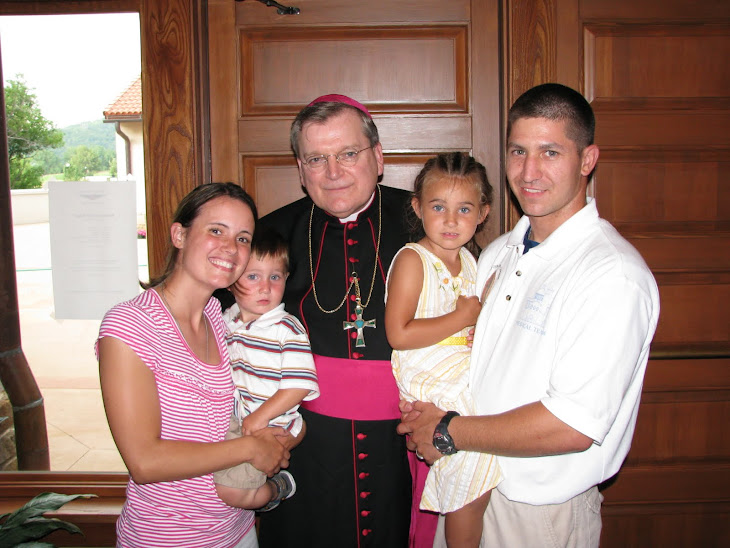
Cardinal Marc Ouellet - You Da Man!!


His Eminence Marc Cardinal Ouellet
Archbishop of Québec
Primate of Canada

Marc Ouellet, PSS (born 8 June 1944 in La Motte, Quebec, Canada) is a Canadian Cardinal of the Catholic Church. He is the present Prefect of the Congregation for Bishops and President of the Pontifical Commission for Latin America since his appointment by Pope Benedict XVI on 30 June 2010. Previously, he was Archbishop of Quebec, and thus Primate of Canada. He was elevated to the cardinalate, by Pope John Paul II, on 21 October 2003.

Early life and ordination


Ouellet was born in 1944 in La Motte, a small village near the city of Amos in northern Quebec. He attended the Teacher Training College, earning a baccalaureate in education, before obtaining a license in theology from the Grand Séminaire of Montréal. On 25 May 1968, he was ordained a priest by Bishop Gaston Hains of Amos.

Professor and theologian

Ouellet spent most of his priestly career as a professor and rector in seminaries. He also received a license in philosophy from the Pontifical University of St. Thomas Aquinas (Angelicum) (1976), and a doctorate in dogmatic theology from the Pontifical Gregorian University (1983).

Bishop

Ouellet was named titular archbishop of Acropolis and Secretary of the Pontifical Council for Promoting Christian Unity on 3 March 2001. Pope John Paul II personally consecrated him as an archbishop, with Cardinals Angelo Sodano and Giovanni Battista Re as co-consecrators, on 19 March of the same year in St. Peter's Basilica.

Archbishop

On 15 November 2002 he became Archbishop of Quebec and Primate of Canada (installed on 26 January 2003), and has been one of the most staunch defenders of the Catholic faith in the Canadian hierarchy.

Ouellet is fluent in English, French, Spanish, Portuguese, Italian and German. He is known for his missionary work in South America.

Cardinal

He was created Cardinal-Priest of Santa Maria in Traspontina by John Paul II in the consistory of 21 October 2003.

He was a cardinal elector in the 2005 papal conclave, and numerous observers believed that Ouellet was papabile himself. A report said that Ouellet had supported Joseph Ratzinger, who became Pope Benedict XVI. Cardinal Ouellet remains eligible to vote in any future papal conclaves that begin before his 80th birthday on 8 June 2024.

Ouellet serves as a member of the Congregation for Divine Worship and the Discipline of the Sacraments, the Congregation for Catholic Education, the Congregation for the Clergy, the Pontifical Council for Culture, and the Pontifical Committee for International Eucharistic Congresses. He takes part in the (generally annual) meetings of these bodies, held in Rome. He is also a member of the Council of Cardinals for the Study of Organizational and Economic Affairs of the Holy See.

A Eucharistic Congress took place in 2008 to commemorate the 400th anniversary of the foundation of Quebec City.

Cardinal Ouellet was elected the recorder, or relator-general, of the 12th Ordinary Assembly of the Synod of Bishops in Rome in early October 2008.

Roman Curia

He is the present Prefect of the Congregation for Bishops and President of the Pontifical Commission for Latin America since his appointment by Pope Benedict XVI on 30 June 2010. He took over from Cardinal Giovanni Battista Re, who had reached the age limit.[1]

Ouellet is associated with Communio, a journal of theology established by Catholics after the Second Vatican Council, and with Hans Urs von Balthasar, a renowned twentieth-century Swiss theologian.

Quiet revolution

He has suggested that changes around the Quiet Revolution in Quebec in the 1960s went too far.

Liturgy

Ouellet has supported a return to Eucharistic adoration and Gregorian chant.

Pastoral approach

A report by the National Catholic Reporter anticipating the 2005 papal election placed Ouellet among twenty papal possibilities ."[P]eople who have worked with Ouellet," said the report, "describe him as friendly, humble and flexible, and a man not so captive to his own intellectual system as to make him incapable of listening to others."

Catholic education

Ouellet was sharply critical of the Ethics and religious culture course of the Quebec education ministry, saying that it relativized the role of faith within the realm of religion and culture. [2]

Church persecutions

Ouellet has argued that the Catholic Church is persecuted in contemporary secular Quebec for telling the truth.[3]

Public apology

In a letter published in Quebec French-language newspapers on November 21, 2007, Cardinal Ouellet publicly apologized for what he described as past "errors" of the Roman Catholic Church in Quebec. Among the errors he wrote about were attitudes, prior to 1960, which promoted "anti-Semitism, racism, indifference to First Nations and discrimination against women and homosexuals."[4][5][6][7] Cardinal Ouellet said his letter was written in response to the public reaction to the statement he submitted to the Bouchard-Taylor Commission, and that it was inspired by a similar letter issued in 2000 by Pope John Paul II.[8]

Abortion

In May 2010 Ouellet stood by his comments that abortion is unjustifiable, even in the case of rape, and urged the federal government to help pregnant women keep their child. He said that "Governments are funding clinics for abortion. I would like equity for organisms that are defending also life. If we have equity in funding those instances to help women I think we would make lots of progress in Canada." Having earlier applauded Prime Minister Stephen Harper's government for its stance against funding abortions in the developing world - praise from which Ottawa quickly distanced itself - he said:"If they do not want to fund abortion abroad and they do not bring at home more help to women to keep their child, I think they are incoherent,.[9]

Wikipedia Article